Your school doesn't have a software problem. It has a seams problem.
Twelve apps, one school, and none of them talking to each other. The cost was never the licences — it's everything that falls through the gaps between them.

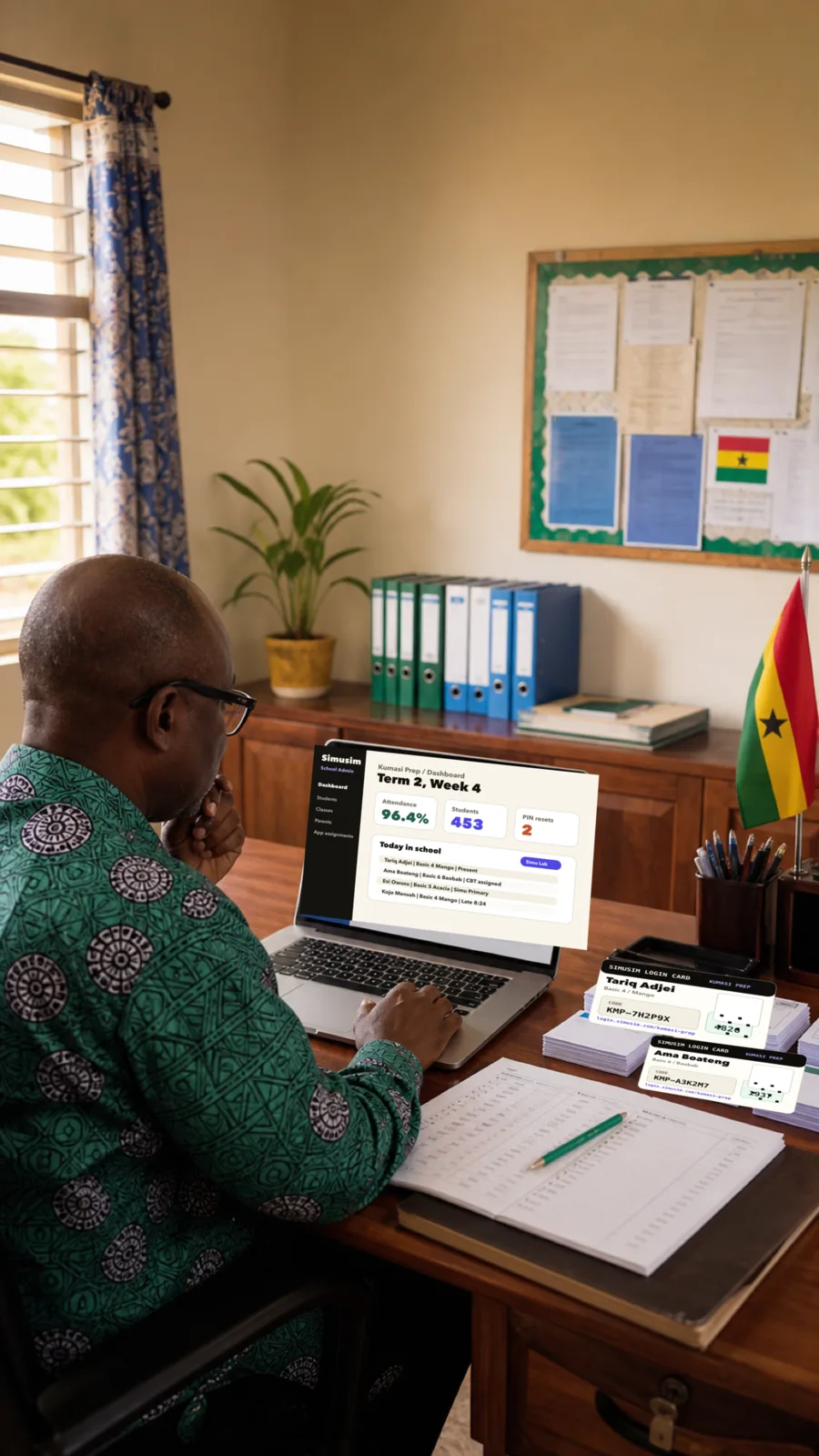
It's 7:40 on a Monday and the school is already running on five different systems, none of which were designed to meet.
Attendance is a paper register the class teacher will, if there's time, copy into a notebook later. Last term's grades live in a spreadsheet on the head teacher's laptop — the file called results_final_FINAL_v3.xlsx. Fees are a cashbook and a growing stack of mobile-money confirmations. Announcements go out on a WhatsApp group three parents have muted and one has quietly left. And every one of those tools asks for a different login, when it asks for one at all.
Here's the thing: each of those tools is fine. The register works. The spreadsheet works. WhatsApp very much works. The problem was never any single app. The problem is the seams — the gaps between the tools, where the same information has to be carried by hand from one system to the next, and where, every single day, a little of it gets dropped.
The cost is reconciliation, not licences
When schools add up what their software costs, they count subscriptions. That's the cheap part. The expensive part is reconciliation — the human hours spent making five systems agree with one another.
Take one child; call her Ama. Ama is "Ama Owusu" in the register, "A. Owusu" in the grade spreadsheet, and "Owusu, Ama K." in the fees cashbook. To anyone in the building she is obviously one girl. To the software she is three unrelated records that nothing can join. So when her father calls to ask why she was marked absent on a day he dropped her at the gate himself, answering him means opening the register notebook, cross-checking the spreadsheet, and scrolling back through WhatsApp — three places, none of which knows the other two exist.
Now multiply Ama by four hundred. The bursar can't see that a child whose fees lapsed two weeks ago is still being marked present every morning. The head teacher can't answer a simple parent question without turning into a detective. The class teacher re-types the same roster into the third app of the week. None of this is in anyone's job description. All of it is the tax the seams charge — collected in small change, every day, forever.
"Just integrate them" makes it worse
The instinct, once you can see the seams, is to stitch them shut — connect the attendance app to the fees app, wire the spreadsheet into the messaging tool. Buy the integration.
But integrations don't remove seams; they multiply them. Each app still keeps its own private copy of "who is a student here." An integration is just a promise that those copies will be kept in sync — a promise that breaks the first time a name is edited in one place and not the other, the first time the internet drops mid-sync, the first time two apps disagree about which Ama is which. You haven't created one source of truth. You've created five, plus a maintenance contract. The seam didn't close; it moved somewhere you can no longer see it.
Start from the person, not the feature
There's a different place to start, and it changes everything downstream. Don't begin with features — attendance, grades, fees — and try to wire them together afterwards. Begin with the one thing the school actually has: people. A student. A parent. A teacher. An administrator.
Give each person a single, secure identity, and have every part of the system read from that one identity instead of keeping its own copy. Now Ama is one record. The register, the gradebook, the fees ledger, the parent's phone — they aren't five apps being integrated. They're one platform looking at the same girl from different angles. There is nothing to reconcile, because nothing was ever forked. Attendance, grades, and fees aren't connected; they're the same system, and the seams simply have nowhere to form.
That's the bet Simusim is built on. One identity per person. Each school owns its own data — every record stamped with exactly which school it belongs to, checked at the edge and again at the data layer. And one source of truth that every app — the portals, the gradebook, finance, the learning apps — reads from directly. No copies, no nightly sync, no tape.
What a school day looks like without seams
The payoff isn't abstract. It shows up in the smallest moments of the day.
A student signs in with one code and one PIN — printed on a card with her name on it — and every app she's allowed to use simply opens. A parent unlocks one screen on a mid-range Android and sees, in one place, that his daughter was present today, scored 14 out of 20 on Friday's test, and has an outstanding balance of two hundred cedis — because attendance, grades, and fees are all looking at the same Ama. The bursar's ledger is the roster, so a lapsed payment and a present mark can finally be part of the same conversation. And when a father calls, the answer takes one look, not four.
That's what "a workspace for the school of yours" actually means. Not another app to add to the pile. Not a slightly better integration between the apps you already fight. One platform, designed as one thing — so the school can stop being the integration layer and get back to the only job that matters: teaching.